Fast when the line grows.
Favorites, search, variants, modifiers, quantities, notes, bundles, discounts, tipping, and multiple tender choices are design goals for a checkout that keeps the conversation moving.
 Careyosity™POS
Built from real market-day experience. Designed for small businesses wherever they sell.
Careyosity™ POS is a small-business point-of-sale vision for faster checkout, connected inventory, flexible products, and freedom to choose payment providers—without making the processor your business system.
Concept project only. No real payments, accounts, or production business data. No launch date or pricing announced.
For markets, pop-ups, boutiques, retail counters, food trucks, cafés, bakeries, concession stands, service counters, and other growing businesses.
The goal is one approachable system for the products, prices, orders, customers, inventory, and reports that belong to your business—wherever the sale happens.
Favorites, search, variants, modifiers, quantities, notes, bundles, discounts, tipping, and multiple tender choices are design goals for a checkout that keeps the conversation moving.
The planned authority is Careyosity POS—not a processor catalog—with shared stock for events, stores, and connected online selling plus safeguards for simultaneous sales.
A provider layer is intended to support Square, Stripe, or future providers without permanently locking products, orders, customers, and reporting to any one processor.
Browser, Android, iPhone, tablet, laptop, and customer-facing display experiences are being explored. Exact app, hardware, and offline support still require validation.
Initial food-service goals may include modifiers, item notes, dine-in or takeout, open tabs, split payments, receipts, and basic kitchen tickets—not advanced full-service restaurant orchestration.
Clear exports, understandable reporting, privacy-minded customer records, and control over business data are part of the direction. Final formats and policies are not yet announced.
Everything above is a direction or development goal—not a commitment that every feature will ship. Providers, hardware, integrations, offline behavior, pricing, and release timing remain under evaluation.
Careyosity sells handmade products at markets and online, so the project starts with firsthand experience: limited counter space, changing connectivity, product variations, bundles, real conversations, and a line that can appear all at once.
Those needs are not unique to a market tent. A boutique, food truck, bakery, café, concession stand, service counter, or online-plus-in-person business can benefit from the same clear checkout and connected operational core.
These mockups are here to help people picture the direction. They are sample concepts, not live product screenshots, and the final product may differ.
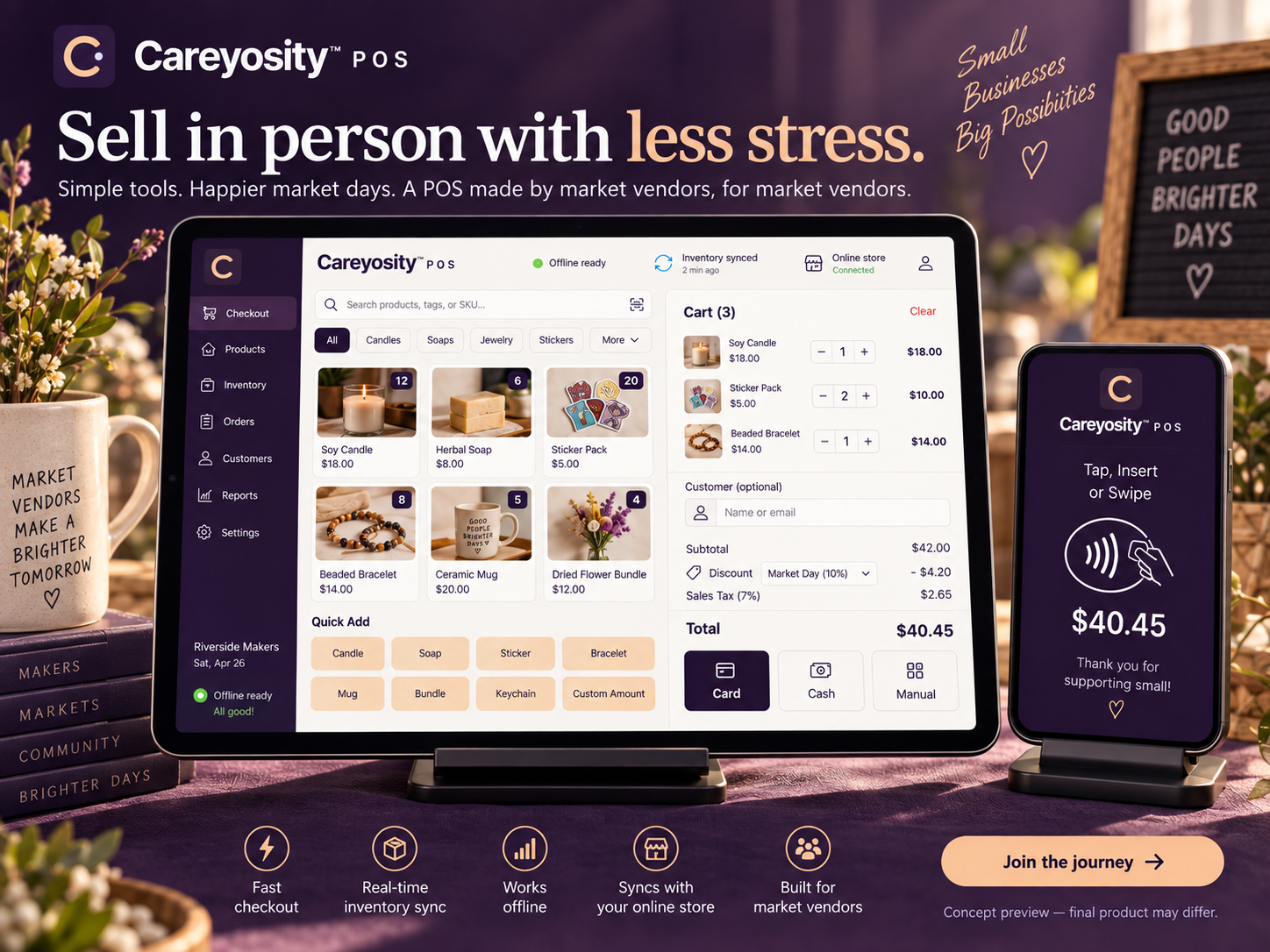
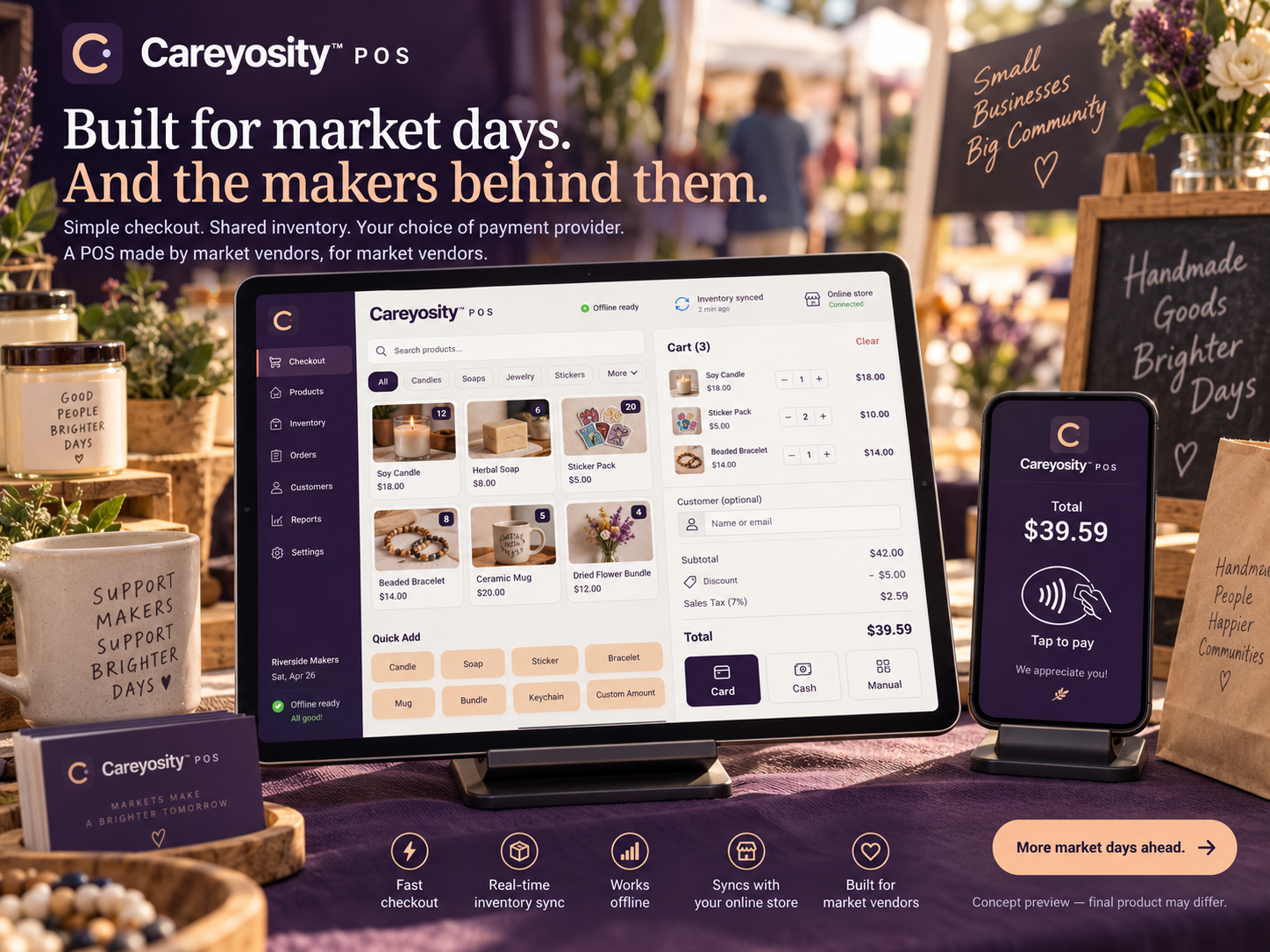
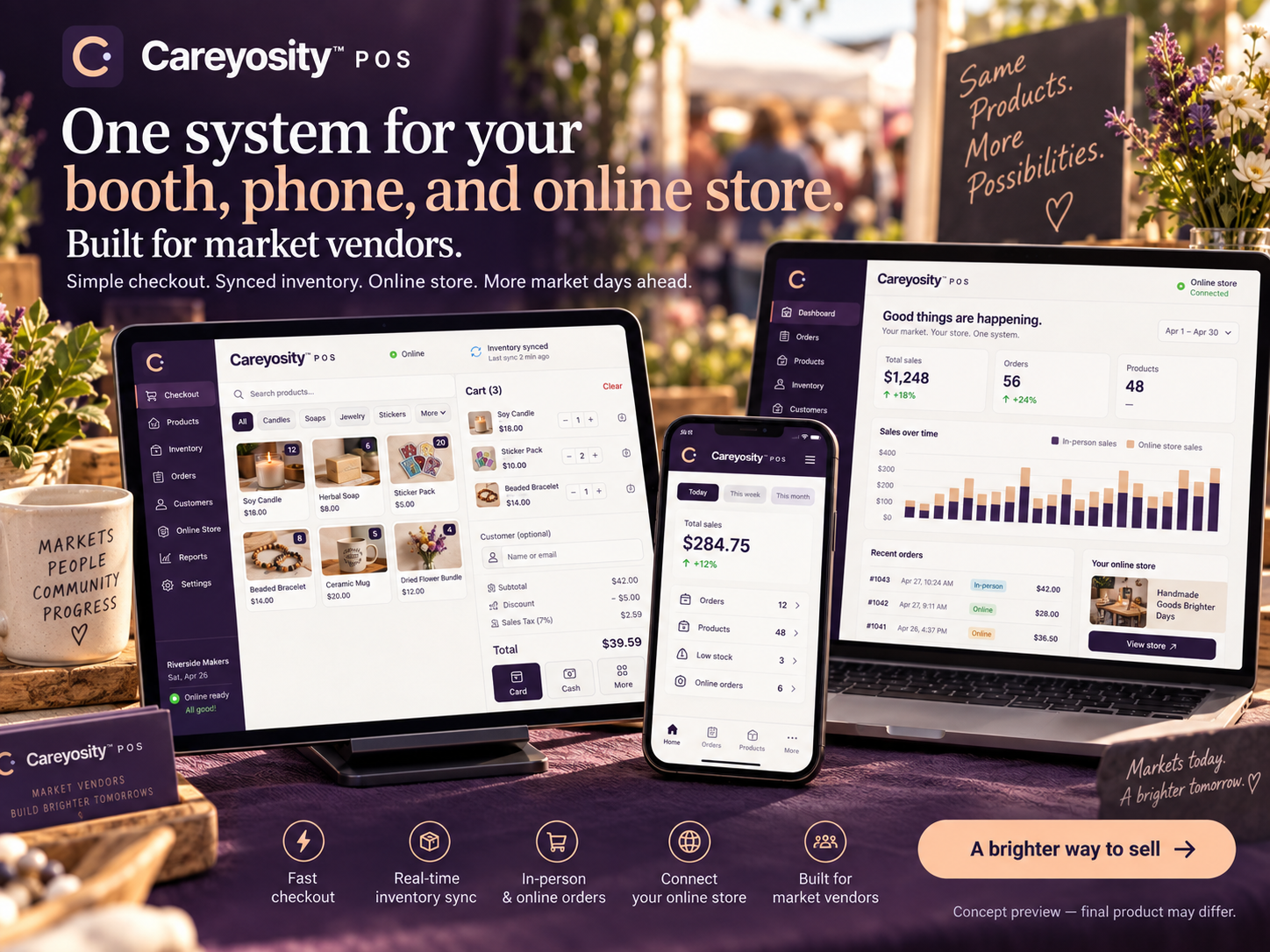
Important: these visuals are concept artwork—not finished-product screenshots. Features, layout, devices, integrations, hardware compatibility, and final design may change.
Define the architecture, inventory authority, payment boundary, selling workflows, and safe concept experience while existing business systems remain untouched.
Validate payment providers, hardware, shared stock, taxes, offline recovery, accessibility, and realistic workflows before depending on them.
Only after real use and careful testing will public availability, supported audiences, pricing, and launch timing be decided.
Not yet. This is a public project page with a safe concept demo and feedback form—not a POS account signup, real checkout, or finished product.
The direction includes farmers markets, craft fairs, pop-ups, boutiques, small retail stores, service counters, food trucks, cafés, bakeries, concession stands, basic restaurants, and businesses that sell both online and in person. Which groups are supported at release will depend on testing.
No. Real market-day experience is the origin and design inspiration, not the boundary. The core positioning is: built from real market-day experience, designed for small businesses wherever they sell.
Retail goals include quick product search and favorites, SKUs, variants, inventory, discounts, bundles, returns, receipts, customer records, and clear reporting. These are development goals; the final release scope is not yet set.
Basic food-service workflows may include modifiers, item notes, tipping, dine-in or takeout, open tabs, split payments or checks, receipts, and basic kitchen tickets or a simple kitchen display. Advanced table maps, seat-by-seat coursing, deep kitchen routing, tip pooling, complex labor tools, and advanced multi-terminal orchestration are not initial promises.
Website integrations are a goal, but no platform list is final. The intent is to connect where practical without forcing every business to replace its current site.
Shared inventory is a major direction: in-person and online sales should use a consistent stock picture with safeguards for simultaneous orders. Exact ecommerce integrations, conflict handling, and sync timing still need validation.
A responsive browser experience is being explored so a phone, tablet, or laptop can participate in the same system. Final browser support, installability, and device requirements are not announced.
Android and iOS experiences are part of the direction. They could include browser-based use, installable web experiences, or native apps, but the final approach and supported OS versions have not been chosen.
Offline-friendly catalog and selling behavior is a goal because events can have unreliable service. Safe reconciliation, taxes, inventory conflicts, receipts, and especially offline card acceptance require careful provider-specific testing, so offline capability is not promised yet.
No permanent processor commitment has been made. Careyosity POS is being designed around a provider abstraction layer that can support integrations such as Square, Stripe, or future providers without making any one processor authoritative for products, inventory, orders, or customers.
No reader, terminal, cash drawer, receipt printer, scanner, or kitchen hardware list is final. Compatible devices must be selected and validated with each provider’s secured SDKs and certification requirements.
No raw card numbers, CVV, magnetic-stripe data, EMV data, or raw payment credentials should enter Careyosity-controlled code, logs, storage, or databases. Real payments would use provider-secured readers, SDKs, and tokenization.
Careyosity POS is intended to remain authoritative for products, SKUs, variants, inventory, pricing, bundles, discounts, orders, customers, receipts, and reporting. A payment processor should not become the permanent inventory source.
Yes, that is a concept being explored for order review, tipping, receipt choices, and provider-secured payment prompts. The final device model and capabilities are not decided.
Printed, email, text, or digital receipt options may be explored, subject to hardware, consent, privacy, and provider constraints. No particular receipt channel is guaranteed yet.
Those are core transaction concepts the architecture should support through the selected payment provider while keeping Careyosity’s order and inventory records consistent. Exact permissions and workflows still need design and testing.
Item and order discounts, fixed-price bundles, and quantity-based offers are part of the product direction. The concept demo includes safe examples; final promotion rules may differ.
Useful sales, product, channel, inventory, tax, event, tender, discount, refund, and basic customer reporting are goals. The exact reports, accounting exports, and integrations are not final.
The goal is to collect only what a business needs, protect it appropriately, make permissions understandable, and avoid putting sensitive payment credentials in Careyosity systems. Final privacy, retention, and account controls will be documented before launch.
Data portability is part of the direction. Products, inventory, orders, customers, and reports should not be trapped behind a processor choice, but exact export formats and contractual terms are not yet announced.
No public pricing, subscription plan, processing rate, or hardware bundle has been announced. Pricing decisions will follow real validation, not precede it.
There is no launch date. The current work is foundation and validation: architecture, concept testing, feedback, hardware and provider research, and real-world workflow proof.
The current public feedback flow uses Turnstile, private D1 storage, explicit contact permissions, and no automatic mailing-list signup. Product security, access control, auditing, backups, retention, and incident response will require separate design and testing before real POS use.
No. Project-update permission is separate, explicit, and unchecked by default. Feedback follow-up and testing interest are separate choices. Active D1 subscriber status is authoritative, and unsubscribe or suppression must be honored.
Choose the separate testing-contact option in the feedback form and provide an email. That records interest only; it is not a reservation, promise of access, or automatic subscription to project updates.
They are concept experiences built with mock data. The Software Preview is interactive, but it cannot take a real payment, create a production order, or touch live inventory or customer data. Every concept area may change.
Unless the page clearly says something is already working on this public project site, product capabilities are goals under exploration. Provider support, hardware, offline behavior, integrations, app availability, pricing, launch timing, and the final feature set are not promises.
Yes. Use the feedback button from anywhere on this page. One idea is enough, and contact permissions remain optional and separate. Please do not include card details, passwords, or customer information.
From a market table to a retail counter or kitchen window, we want to understand the small-business problems worth solving.
Share an idea in the form, or use the email link above. No one is subscribed automatically; project updates require a separate opt-in. Please do not include card details or other sensitive information.